Adding the Device at app.litmusnvr.com
If you can't open the local screen, add the device to your Litmus account at app.litmusnvr.com or in the Litmus app. Once added, you can watch video and change settings from anywhere, just as when you connect from the local screen. The device must stay connected to the internet.
Before you begin
- Create a Litmus account and sign in at app.litmusnvr.com or in the Litmus app.
- To add the device from a different network, have its Device ID ready. The Device ID is a 16-character code made up of the digits 0 to 9 and the letters a to f.
- Windows: Right-click the Litmus icon in the notification area and click About.
- macOS: Click the Litmus icon in the menu bar, then click About Litmus NVR.
- Linux: The installer prints it when installation finishes. You can also run
systemctl status litmus.
Adding the device
- Open Device Manager. If your account has no places yet, click Connect device on the Connect your device screen shown after you sign in. If you already have places, click the place name at the top left, then click Add place. If no device is registered yet, the Add Device screen opens directly.
- Select the device. If you're on the same network as the device, it appears under Devices on Local Network, and the first device found is selected with its Name and Device ID filled in. If you're on a different network, enter a Name and the Device ID.
- Click Add Device. You return to the list with the new device selected.
- Click Connect.
After the device connects, its place is added to your account and opens. For a device you used on the local screen, that place keeps its settings and history; for a device without a place, a new place is created. A device you've added connects automatically whenever you open the app, even from another network. The local screen and remote access use the same settings stored on the device, so changes made in one appear in the other. If the local screen is already open, reload it to see the changes.
If the device is in use by a place in another Litmus account, This device is registered to another account. Remove it from that account and try again. appears and no place is added.
If the device's place is in the trash, the This device's place is in the trash window appears. Click Restore to restore the place; the page reloads and opens it, and you can keep using the device's settings and recordings.
When the device has settings for another place
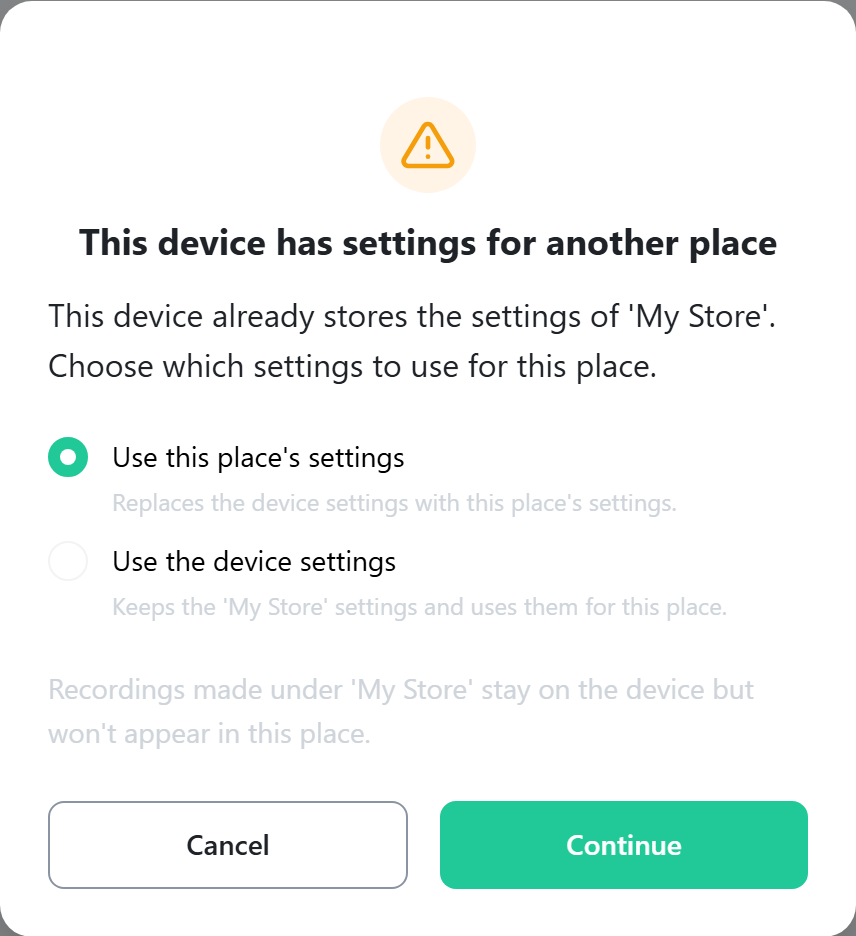
If you use Connect device in a different place that already exists on the web to connect a device that was set up on the local screen, the This device has settings for another place window appears. It doesn't appear when you connect from Add place or the Connect your device screen. A device can store settings for only one place, so you need to choose which settings this place uses.
| Option | What happens |
|---|---|
| Use this place's settings | Replaces the device settings with the web place's settings. |
| Use the device settings | Keeps the cameras and actions you set up on the local screen and uses them for this place. After this, restart the device once so it runs with those settings. |
| Cancel | Changes nothing. You're asked again the next time the device connects. |
Choose an option and click Continue. The page reloads.
Offline devices, the relay server, and Multi-site view
- With remote access, settings are read from the device. If the device is off or offline, a notice appears at the top of the screen and you can't change settings. The notice disappears when the device reconnects.
- On most home and office networks, the app connects to the device directly. If the network blocks direct connections, video passes through the relay server, and that data counts toward your account's relay server allowance. You can see the connection type in Settings > Device.
- Multi-site view shows cameras from several places on one screen. It appears at the top of the place menu when your account has at least one device running device software 2.0 or later.